When AI Answers Your Buyers, Does It Mention You?
If you don't know your Share of Model, you don't know your AI pipeline risk.
Your buyer opens ChatGPT and types: "What's the best vector database for production use?" The model answers in four sentences. It names Pinecone, Weaviate, and Milvus. It does not name you.
That moment — quiet, untracked, happening hundreds of times a day — is the new first-touch. And right now, most B2B SaaS companies have no idea whether they're in that answer or not.
The metric you're not tracking yet
Share of Model (SoM) measures how often, how prominently, and how favorably your brand appears in generative AI responses compared to competitors. It's the AI-era equivalent of Share of Voice — except the stakes are higher, because the answer is singular. A Google results page lists ten blue links. An AI answer names three brands. Maybe four.
SoM gives you three specific numbers to chase:
The percentage of AI answers that mention your brand unprompted, when buyers ask category-level questions
The percentage of AI models that surface your brand when buyers ask about it directly
Your rank among the brands AI consistently names in your category
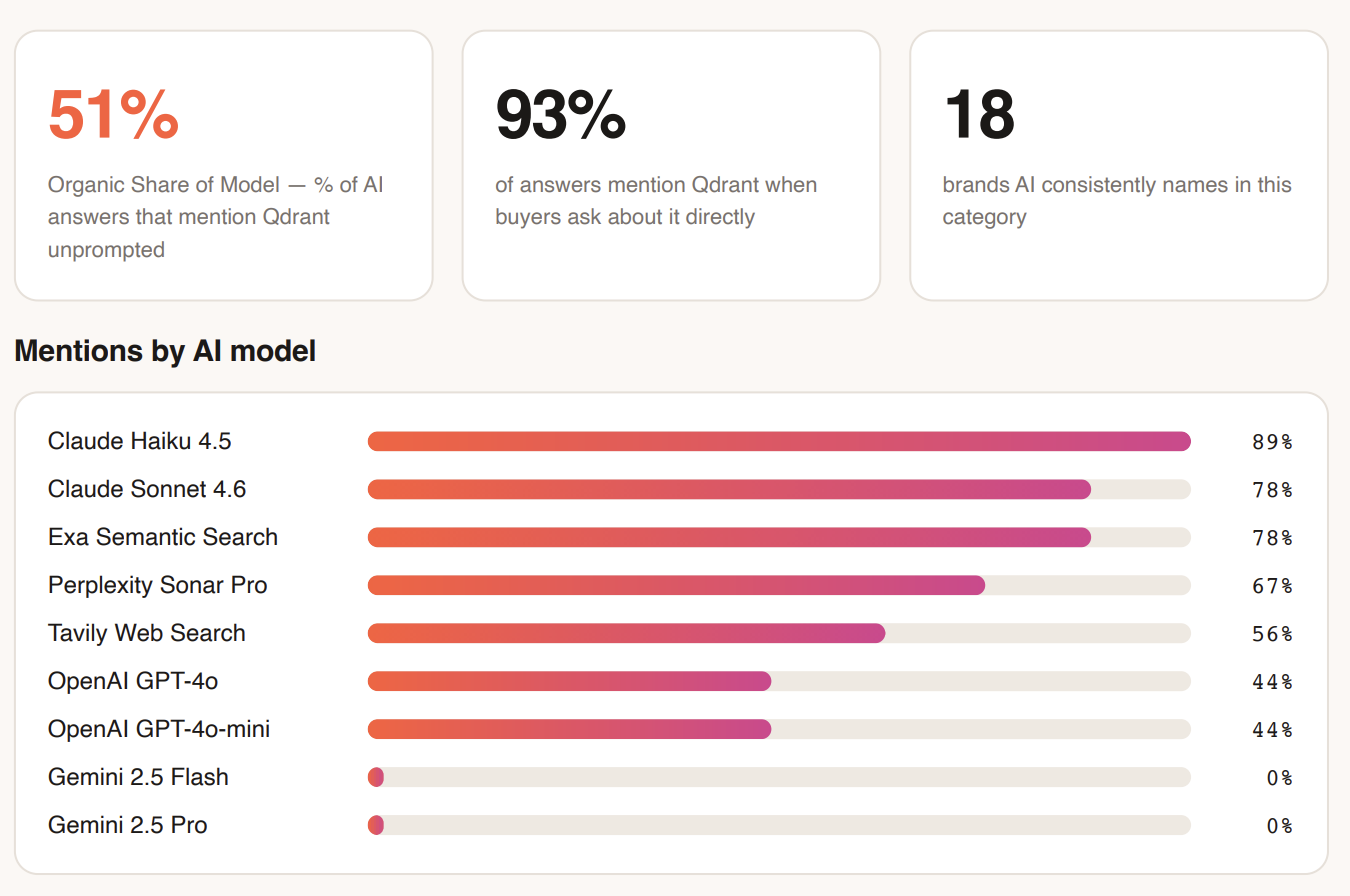
Those three numbers tell you where you actually stand — not where your positioning deck says you stand.
A real example: Qdrant's competitive position
The vector database space is a useful case study. When we ran Qdrant through a wide range of AI models and category-level prompts, the data showed 18 brands consistently surfacing in that segment. Qdrant appeared in fourth position — after Pinecone, Weaviate, and Milvus.
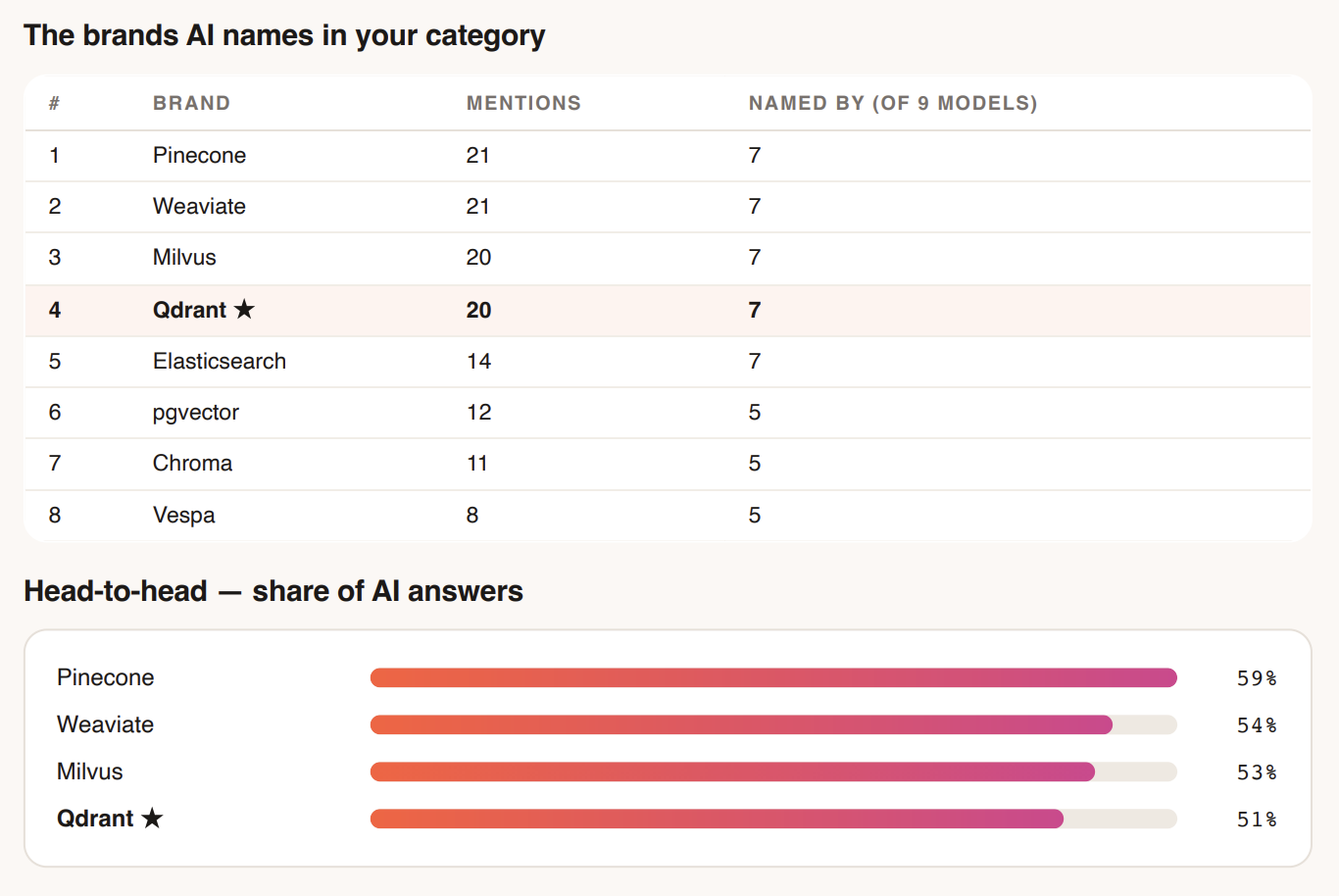
That single data point is more honest than any analyst report. It tells you the competitive order that AI has learned, which reflects the citation patterns, documentation depth, and third-party coverage each brand has accumulated across the web. It's not opinion. It's pattern.
Knowing you're fourth is the beginning. The next question is where you're fourth — and whether that's uniform across use cases, or whether there are specific industries or applications where you rank first or second. That's where SoM stops being a vanity metric and starts driving allocation decisions.
Why the hackathon prompt was exactly right
A recent hackathon surfaced the exact right problem statement: "Help companies figure out what AI thinks of them." The insight behind that prompt is correct. Most companies have no structured answer to it. They know their Google rankings. They know their G2 badge tier. They have no idea whether Claude recommends them when a buyer in their ICP asks the question they're supposed to own.
That gap is not a branding problem. It's a revenue problem. Pipeline that never starts because your brand was absent from the AI answer doesn't show up in your CRM as lost — it just never existed.
Data without action is just a report
Measuring your SoM once is interesting. Tracking it weekly is how you build a growth channel. The baseline tells you where you are. The trend tells you whether your content, PR, and community investments are changing the model's perception — or not.
Here's what that motion actually looks like in practice:
Run structured prompts across models. ChatGPT, Claude, Gemini, and Perplexity each have different training emphases and citation tendencies. Your SoM can differ significantly between them. Test category-level questions, use-case questions, and competitor comparison questions separately — they return different competitive sets.
Map the competitive set, not just your position. If 18 brands show up in your category, you need to know which ones appear ahead of you and on what prompt types. That tells you where the citation gap is and what content or coverage they have that you don't.
Drill into use cases and verticals. A fourth-place finish in general category queries might coexist with a first-place finish in a specific vertical or use case. That's where you double down — not to protect a broad ranking you don't have, but to deepen the one you do.
Treat citation sources as a lever. AI models cite what the web repeats and vouches for. Trade press coverage, technical documentation cited by practitioners, independent comparison posts, community threads — these are the inputs the model weights. If none of those exist for your brand in a given use case, your SoM in that use case will be zero. That's fixable, but it takes deliberate content and PR investment, not a homepage rewrite.
The idea vs. the business problem
The hackathon prompt above was good because it identified a real pain. But knowing AI visibility is measurable is not the same as having a systematic process to track it, interpret it, and connect it to specific GTM actions. Most teams that try to DIY this end up with a spreadsheet of spot-checks that gets stale in two weeks.
The companies pulling ahead on AI visibility are running this as a recurring measurement program — consistent prompt sets, consistent model coverage, consistent competitive benchmarking — so that when they ship a new integration page or land a TechCrunch mention, they can see whether it moved the number within the next tracking cycle.
The action worth taking this week
Get your SOM Audit to make sure you are on top of the data today and can work off data and not a "feeling". Contact us for running your first SOM Audit and determining what extra-detail questions are those that you need to ask to decide on your most important 3 next steps to move your AI Visibility up.