If You Love Writing, You Can Code
The blank page, the resistance, the flow — it's all the same thing.
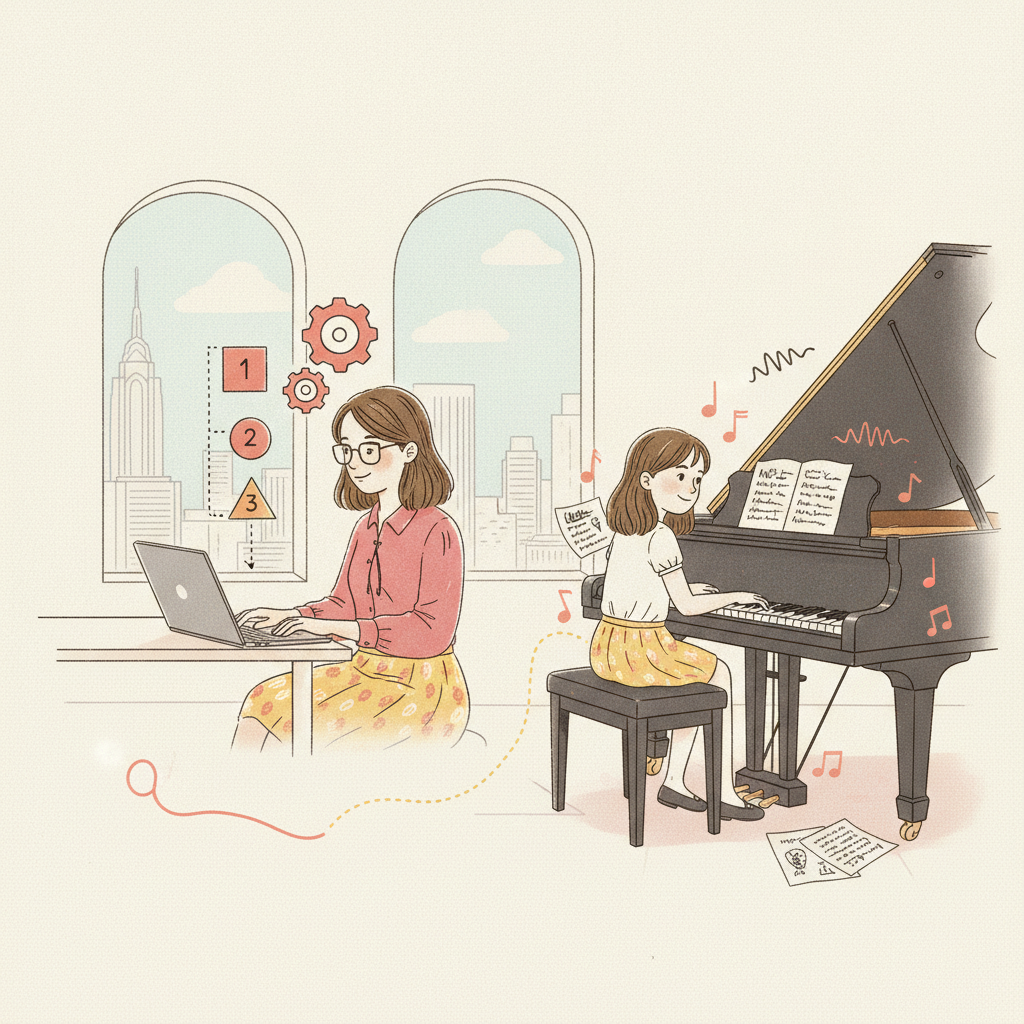
Writing and coding are the same thing. I don't mean that metaphorically. I mean it almost literally — and once you feel it, you can't unfeel it.
I came to this slowly, through three different loves that turned out to be one.
Piano first, then words, then code
I played piano as a kid. Hated it at first — the repetition, the discipline, my fingers refusing to do what my brain imagined. Then something shifted. The better I got, the more I loved it. There's a particular joy that lives on the other side of competence, when the mechanics stop fighting you and the music just comes through your hands. I eventually stopped playing regularly. I still sit down at a piano occasionally, and that joy is still there, unchanged.
Writing followed a similar arc. Short stories, then poetry, then essays, then articles, then back to poems — always whatever floated to the surface. The form kept changing. The feeling didn't. Blank page, resistance, something building, and then a moment where the piece finds its shape and you read it back and think: yes, that's it.
Then I discovered coding. And I recognized the feeling immediately.
Coding is literally writing — not a metaphor
When people say "coding is like writing," they usually mean it loosely — both require creativity, both take practice, both involve problem-solving. That's true but undersells it.
As the writer at Rust Red River describes it: in almost every modern programming language, any language where source code contains words, you are engaging with what you type semantically — making choices about vocabulary and meaning. That's not craft-speak. That's just true. You are writing. The medium is different; the act is the same.
R.O. Phillips makes the parallel explicit: both writing code and writing fiction start from a blank page with no clear destination. Both involve a messy first draft — ugly working software, or snatches of dialogue and self-notes that look hopeless. Both require an editing pass where you remove the extraneous, find the patterns, make the whole thing smaller and more precise. The principle Phillips lands on: keep it as small as it can be and still work. Remove everything that doesn't need to be there. Writers know this rule. It's just good writing.
What I find beautiful is where the outputs go. Phillips notes that published software runs on hardware; published stories run on what he calls "reader's wetware" — and MRI studies show that readers' brains simulate fiction as if actually experiencing it. Different machines. Same goal: something you made runs somewhere and produces a real effect in the world.
Piano: music comes to life through your hands.
Writing: text comes to life on a page.
Coding: a product comes to life through language.
Fingers on a keyboard. Brain focused on the thing. Something being made.
The blank page is the same blank page
The neuroscience research described by The Uncomfort Zone gives this a name: "creative toggling." Your brain alternates between generating raw material and shaping it into something coherent. It happens in writing. It happens in coding. The pattern is identical — vague idea, a mess, iteration, and then the moment where the thing clicks and you're in flow.
I know that click. It's the same feeling when a poem suddenly has its final line, or when a piece of code finally runs the way you meant it to, or when your fingers find a phrase on the piano you didn't know you were looking for. The sensation is not discipline or craft or technical skill. It's recognition. That's the thing I was trying to make.
The Rust Red River writer says something I've thought about a lot: writers create multiple drafts and discard what no longer works; programmers rarely start from scratch — and this is where the craft suffers. They describe "git commit regret" as a creative phenomenon, where a messy commit history is just an evolving understanding of how the narrative needs to be written. Every writer recognizes that. Every draft you've abandoned is a commit you regretted. The medium is different. The experience is not.
David McCullough said "writing is thinking. To write well is to think clearly. That's why it's so hard." The Rust Red River writer applies that quote to code, and I think it's exactly right. The hardest part of coding isn't syntax. It's thinking clearly enough to say what you actually mean.
With AI coding agents, you're mostly just writing
Here's what changes everything for writers who've been intimidated by code: AI coding agents have collapsed the gap between writing and building almost completely.
When I build with tools like Cursor, Claude, or v0, I'm not memorizing syntax. I'm writing. I describe what I want in plain language. I explain the problem. I push back when the output isn't right. I refine. The agent writes the actual code; I write the conversation that steers it. And a real product comes out the other side.
This is not a workaround. This is the skill. Writing clearly about what you want, catching when the output drifts from your intent, knowing when something feels off even if you can't immediately say why — these are writing skills. They transfer completely.
I'm not saying you'll never need to understand what the code is doing. You will, eventually, want to look under the hood. But the entry point is a conversation. And if you can write, you can have a conversation.
Now is the exact right moment to try
If you've always thought "code — no way, that's not for me," I understand that. I felt it too. Code looked like a foreign language I hadn't earned the right to speak.
But here's what I actually think: the reason coding felt foreign to writers wasn't the logic. It was the syntax barrier — the curly braces and semicolons and error messages that told you nothing useful. That barrier still exists if you sit down with raw code and no help. With AI coding agents, it's mostly gone. What's left is the part writers are already good at: thinking clearly, writing precisely, iterating until it sounds right.
The Uncomfort Zone writer puts it simply: "You don't need to be 'a writer' to write. Or 'a founder' to build something. Or 'ready' to begin. You just have to start." Writing felt more vulnerable to them than coding — every word felt like a choice. I felt the reverse when I started coding. But the vulnerability is the same, and so is what's on the other side of it.
Pick something small you actually want to exist. A simple tool, a personal site, something that would make your own work easier. Open a conversation with an AI coding agent and describe it the way you'd describe it to a smart friend. Write clearly. Push back when it's wrong. Revise.
You've done this before. You just called it writing.